Decay Heat Removal System. Advanced passive pwr relies on passive systems to cool reactor core and containment, such as the passive residual heat removal system (prhr), passive injection system and passive containment cooling system (pccs). Generator inside a heat exchanger.
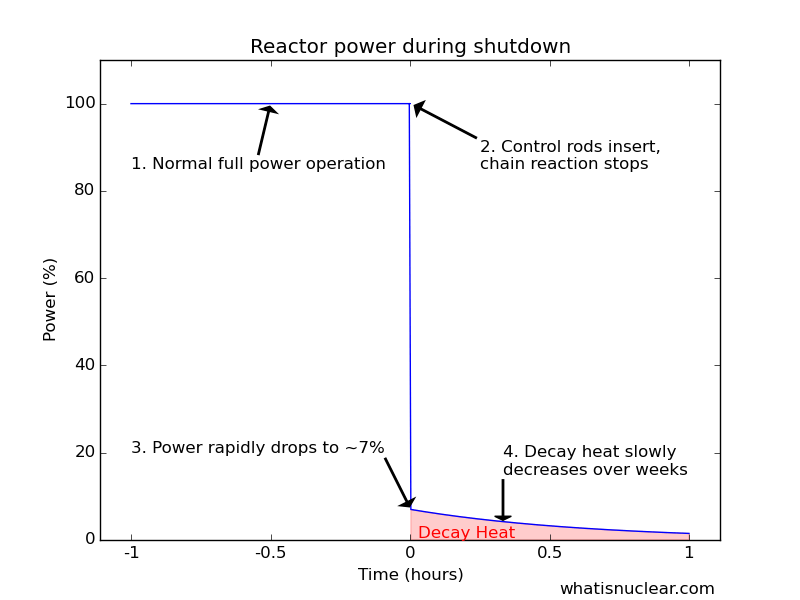
Understanding Decay Heat from whatisnuclear.com
The conclusion was reached that the best way to improve the reliability of pressurized water reactor (pwr) decay heat removal is first to focus on improving the reliability of the auxiliary feedwater and high pressure. Generator inside a heat exchanger. Moreover, the highest temperature occurs at the upper surface of the core.
The Conclusion Was Reached That The Best Way To Improve The Reliability Of Pressurized Water Reactor (Pwr) Decay Heat Removal Is First To Focus On Improving The Reliability Of The Auxiliary Feedwater And High Pressure.
Heat removal through steam generators. The heat removal rate is about 3 % of decay heat when the decay heat removal from the secondary system is ended by depletion of water in the steam generator at sbo accident. (2) for a passive system reliability estimation of decay heat removal (dhr) of a nuclear power plant.
Decay Heat Removal System (L.0 Introduction 1.1 System Functions The Functions Of The Decay Heat Removal System (Diirs ) Are As Follows:
In nuclear power plants (npp) decay heat removal is one of the main safety concern. Generator inside a heat exchanger. Removes decay heat from the reactor core following a reactor shutdown and removes residual heat from upper reactor vessel internals during a cooldown.
And Steam Piping Configured To Deliver.
Heat is removed during normal power operation by generating steam in the reactor vessel and then using that steam to generate. Methods for removing decay or residual heat from a reactor core can be grouped into two general categories: Decay heat removal, the total decay heat removal by hybrid control rod is 1.2 mw.
Redundant And Diverse Decay Heat Removal Systems Are Available In Majority Of Npp.
Advanced passive pwr relies on passive systems to cool reactor core and containment, such as the passive residual heat removal system (prhr), passive injection system and passive containment cooling system (pccs). One category includes methods which circulate fluid through the reactor core in a closed loop, using some type of heat exchanger to transfer heat out of the system. Decay heat removal system design in various countries.
• Fuel Pool Cooling Mode:
The proposed dhr uses atmosphere as. The success criteria of the system depend on three types temperature that do not exceed their respective design safety limits and are considered as dependent variables and 14 significant parameters were used as independent variables. The system is implemented by branching off the secondary heat transport system as shown in fig.
Decay Equation Half Life . Then, a = 800 (1/2) 30000/6000. Suppose we look at a sample at a specific time t 1 > 0 and then at a later time t 2 > t 1. What is the halflife of a firstorder reaction with a from socratic.org The differential equation of radioactive decay formula is defined as. So, when we’re dealing with half life specifically, instead of exponential decay in general, we can use this formula we got from substituting y = c / 2 y=c/2 y = c / 2. If playback doesn't begin shortly, try restarting your device.
What Type Of Energy Is Nuclear Fission Reactors . The total energy released in a reactor is about 210 mev per 235 u fission, distributed as shown in the table. It is where the nuclear chain reactions occur that produce energy by fission. Decolonizing energy and the nuclear narrative of small from policyoptions.irpp.org Not to mention, there are two ways to harness nuclear power. This type of energy production is often viewed as a viable option to burning fossil fuels. The principles for employing nuclear power to generate electricity are identical for most types of reactor.
What Is Time Decay Of Call Options . To be clear, only an option’s extrinsic value decays away as time passes. An option’s intrinsic value is the option’s real value at any given moment, and intrinsic value does not decrease with the passing of time. How To Increase Your Options Trading Success from www.netpicks.com Due to time decay, stock options are classified as wasting assets. Options contracts tend to decrease in value as they get closer to expiration. It's basically the reduction in value of an options contract as reaches its expiration date.


Komentar
Posting Komentar